

Invoice disputes can bring an otherwise straightforward payment to a complete standstill.
A customer queries an invoice, the accounts team puts it on hold, and suddenly a payment you were expecting this month has no confirmed payment date.
Sometimes there’s a genuine disagreement about the work, price or terms. Sometimes there’s a missing purchase order, an incorrect reference or a customer who claims nobody authorised the extra work.
And occasionally, the dispute only appears after you’ve chased an overdue invoice.
I’ve spent much of my career dealing with overdue payments, first through Franklin James Credit Management and now through Eight Owls. One thing I’ve learnt is that a surprisingly small administrative issue can leave a substantial invoice unpaid for weeks when nobody takes responsibility for resolving it.
The longer it sits, the more complicated the conversation can become.
In this guide, I’ll explain how to handle an invoice dispute, the eight common causes worth looking out for and how to stop the same problems delaying payment again.
What is an invoice dispute?
An invoice dispute happens when a customer challenges an invoice because they disagree with something they’ve been charged for, how much they owe or whether the goods or services meet the original agreement.
Disputes can concern anything from incorrect VAT charges to a substantial disagreement over the quality of completed work.
The important thing is understanding exactly what the customer is disputing.
There’s a considerable difference between a customer saying:
- “The invoice doesn’t have our purchase order number.”
- “You’ve charged us £500 more than we agreed.”
- “The work hasn’t been completed to the agreed specification.”
- “We’re not paying because we’re unhappy with the service.”
Each requires a different response.
I would also distinguish between a genuine dispute, an administrative query and a customer who may be using a vague objection to delay payment. You need evidence before drawing that last conclusion.
My rule is simple: every disputed invoice needs a documented reason, a named person responsible for resolving it and a clear next action. Queries should be dealt with asap!
Without those three things, the invoice can sit on your aged debtor report while everyone assumes somebody else is dealing with it.
How to resolve an invoice dispute in 6 steps
If you’re dealing with a disputed invoice right now, this is where I’d start.
1. Find out exactly what the customer is disputing
Avoid sending another standard payment reminder once a genuine dispute has been raised.
Contact the customer and ask them to explain precisely which part of the invoice they’re challenging and why.
Useful questions include:
- Which invoice or line item are you disputing?
- Is the issue with the price, quantity, work delivered or another detail?
- What amount do you believe is incorrect?
- Do you have supporting documentation?
- Is there any other reason preventing the remaining balance from being paid?
I prefer to have this conversation by telephone where practical, particularly when the customer has already exchanged several emails without reaching a resolution.
A conversation often reveals details that weren’t included in the original objection.
Follow it up in writing so that both parties have an accurate record of what’s been agreed.
2. Check your own records before challenging the customer
This sounds obvious, but it’s an important step.
Before defending an invoice, establish whether your business has made a mistake.
Check the original quotation, signed agreement, purchase order, delivery notes, timesheets, relevant emails and any evidence of completed work.
Make sure the invoice reflects what was actually agreed.
I’ve always believed that businesses should be prepared to challenge their customers when appropriate, but they also need to acknowledge their own mistakes quickly.
If you’ve charged the wrong amount, correct it. If you’ve missed information, provide it. If the customer has raised a legitimate service complaint, get the right person involved.
Defending an incorrect invoice achieves very little. Correcting it promptly gives you a much stronger position when asking for payment.
3. Establish whether it’s a genuine dispute or an administrative delay
This is where good credit control judgement becomes particularly valuable.
A missing purchase order number may be preventing an invoice from entering the customer’s payment system. That’s generally an administrative problem you can work towards resolving quickly.
A disagreement about whether contracted work was completed is more substantial.
And a customer who repeatedly gives vague reasons for withholding payment may require a different approach again.
Don’t automatically classify every queried invoice as a disputed debt.
Ask what evidence is needed, who can provide it and what would allow the customer to release payment.
4. Give the dispute to someone who can actually resolve it
Your credit controller may be responsible for identifying and following up a disputed invoice, but they won’t always have the authority or technical knowledge to resolve it.
If the customer says the work wasn’t completed correctly, somebody from operations or service delivery may need to investigate.
If the issue concerns pricing, the salesperson or account manager may need to confirm what was agreed.
If the invoice contains an error, finance needs to correct it.
One of the weaknesses I look for in credit control processes is whether these responsibilities are clearly defined.
An invoice shouldn’t remain unpaid simply because the finance team is waiting for another department to respond.
Set an owner and an internal deadline for the investigation. For straightforward administrative queries, I’d aim to resolve them within one or two working days where possible. More complex contractual disputes will need a realistic timescale agreed with the customer.
5. Establish whether the undisputed amount can be paid
Let’s say you’ve invoiced a customer £6,000.
They’ve challenged an additional charge of £500, but they’re satisfied with the remaining £5,500.
I’d ask whether the undisputed £5,500 can be processed under the agreed payment terms while the remaining £500 is investigated.
Check the contractual position before assuming the customer must make a partial payment. Some disputes and contract terms affect whether an amount is genuinely separable.
This approach can still be commercially sensible for both parties. It identifies the actual disagreement and gives the customer an opportunity to pay what they accept they owe.
6. Confirm the resolution and agree the payment date
Once you’ve resolved the dispute, don’t assume the customer will automatically arrange payment.
Confirm in writing:
- What the original dispute concerned.
- What evidence or explanation was provided.
- Whether the invoice has been accepted or corrected.
- Whether a credit note or replacement invoice is required.
- The amount now payable.
- The agreed payment date.
If the dispute is closed, make sure the accounts payable team knows that payment can proceed.
A resolved invoice dispute still needs a payment confirmation.
I’ve seen how easily a query can be marked as closed internally while the customer continues to hold the invoice in their payment system.
That’s why I would keep responsibility for the account open until payment has been received or a separate agreed collection action is in place.
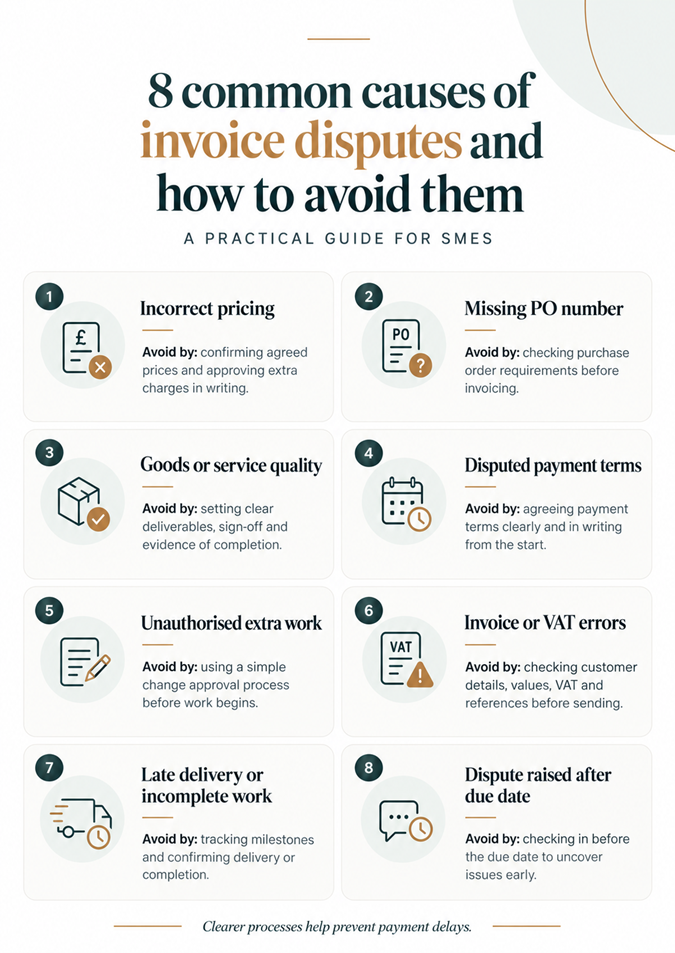
8 common causes of invoice disputes and how to avoid them
Most invoice disputes fall into a relatively small number of categories.
The details vary by business, but these are eight causes I’d pay particular attention to.
1. Incorrect pricing or unexpected charges
The customer agreed one price but received an invoice for another.
This might happen because someone used an outdated price list, misunderstood a quotation or added charges that hadn’t been formally approved.
How I’d handle it: Go back to the original quotation and agreement. Confirm exactly what was authorised and when. If the charge is correct, provide the supporting evidence. If your business made an error, correct it promptly.
How to prevent it: Require written approval for additional charges and make sure the invoicing team has access to the latest agreed pricing.
2. Missing or incorrect purchase order numbers
This is one of the most frustrating causes of delayed payment because the underlying work may be completely undisputed.
Some customers won’t process an invoice without a valid purchase order number.
The person who instructed the work may have forgotten to raise the purchase order, used the wrong reference or assumed somebody else had dealt with it.
How I’d handle it: Find out who can authorise or provide the missing information. Ask accounts payable to confirm exactly what’s required and whether the invoice can then enter the current payment run.
How to prevent it: Confirm purchase order requirements before accepting work and include the correct reference when the invoice is first issued.
The Small Business Commissioner also recommends obtaining purchase order information early to avoid preventable payment delays.
3. Disagreements about goods or service quality
These disputes usually need more investigation.
A customer may argue that goods were defective, a project wasn’t completed properly or the service didn’t meet their expectations.
How I’d handle it: Compare the complaint with the agreed specification and gather evidence. Speak with whoever delivered the work and ask the customer to identify the specific shortfall.
Where there’s a genuine problem, agree the appropriate remedy. Where the work meets the agreed specification, explain your position with supporting documentation.
How to prevent it: Set clear deliverables, acceptance criteria and sign-off procedures. Keep evidence that the goods or services were supplied as agreed.
4. Disputed payment terms
You believe payment was due within 30 days. The customer believes they agreed to 60.
I’ve encountered situations where the person placing an order and the person responsible for payment are working from different expectations.
How I’d handle it: Check the contract, account-opening documents, purchase order and written correspondence to establish the agreed terms.
How to prevent it: Confirm payment terms before supplying goods or services, including precisely when the payment period begins.
Terms should be visible, agreed and consistently applied across sales, finance and customer accounts.
5. Additional work that wasn’t properly authorised
This is particularly relevant to service-based businesses.
A customer asks for something extra during a project. Your team completes the additional work, but nobody formally agrees the cost.
The customer then receives an invoice they weren’t expecting.
How I’d handle it: Establish who instructed the work, what was communicated about the additional cost and whether you have evidence of approval.
How to prevent it: Introduce a simple variation or change-control process. Additional work should have a clear scope, price and approval before it goes ahead.
A quick email confirming an agreed variation can prevent a much longer argument later.
6. Incorrect invoice details or VAT charges
Even small mistakes can cause an invoice to be rejected.
Common examples include incorrect customer details, duplicate invoices, miscalculated amounts, incorrect VAT treatment and missing invoice references.
How I’d handle it: Check the error, correct the relevant documentation and confirm whether the customer needs a credit note or replacement invoice. VAT corrections should follow the applicable HMRC rules.
How to prevent it: Check invoice accuracy against the original order and relevant tax requirements before sending it.
I would also review whether recurring errors are linked to manual invoicing or poor information being passed between departments.
7. Late delivery or incomplete work
A customer expected goods or services by an agreed date, but delivery was late or incomplete.
They may now question whether payment is due or whether they should receive a reduction.
How I’d handle it: Review the contractual delivery obligations, what was supplied and any agreed changes. Establish whether the customer is entitled to a remedy.
How to prevent it: Agree clear delivery milestones, document changes and communicate delays before the customer discovers them.
Where possible, obtain completion or delivery confirmation as part of the normal invoicing process.
8. A dispute raised only after payment becomes overdue
This is the one I’d pay particularly close attention to.
An invoice has been outstanding for several weeks. Your business sends reminders and perhaps makes a telephone call.
Then, suddenly, the customer says there’s a problem with the invoice.
Sometimes the query is genuine and has simply been raised late.
Other times, the customer hasn’t provided a specific explanation despite repeated requests.
How I’d handle it: Ask for the exact nature of the dispute, the amount being challenged and the evidence supporting it.
Check the history of the account. Has the customer previously accepted the work? Have they acknowledged the balance or promised payment? When was the objection first raised?
These details help establish what has happened and what needs to happen next.
How to prevent it: Contact customers before payment falls due, particularly on larger invoices, to confirm they’ve received the invoice and have everything needed to process it.
Don’t wait until an account is substantially overdue to discover there’s an issue.
What should you say when a customer disputes an invoice?
Your first response should establish the facts and move the query towards resolution.
Here’s wording I’d use as a starting point.
Example: responding to a disputed invoice
Subject: Invoice [number] – clarification required
Hi [Name],
Thanks for letting me know there’s an issue with invoice [number].
I’d like to get this resolved as quickly as possible. Could you confirm which part of the invoice you’re disputing, the reason for the query and whether you have any supporting information we should review?
I’ll look into this with the relevant team and come back to you with an update by [date].
In the meantime, could you also confirm whether the remaining balance of £[amount] is approved for payment in accordance with our agreed terms?
Kind regards,
[Name]
I would adapt the wording depending on the customer’s relationship with the business, the age of the debt and what’s already been discussed.
There’s little benefit in sending a formal-sounding demand when you haven’t established the facts.
Equally, once you’ve investigated the issue and confirmed the balance is payable, you need to move the conversation towards a definite payment commitment.
When should you escalate a disputed invoice?
If a dispute remains unresolved, the next step depends on what is actually preventing agreement.
I would usually separate accounts into three categories:
| Situation | Recommended action |
|---|---|
| A genuine quality, pricing or contractual disagreement | Investigate the evidence, agree a resolution route and consider mediation or legal advice where necessary. |
| An administrative query that remains unresolved | Escalate internally and with the customer’s relevant purchasing or finance contact. |
| A payment that remains outstanding after the dispute has been resolved | Resume the appropriate credit control process, confirm payment commitments and consider formal recovery if necessary. |
A genuine contractual dispute deserves proper attention. Standard collection reminders are unlikely to resolve the disagreement.
If the dispute cannot be settled directly, options may include negotiation, mediation, specialist legal advice or proceedings appropriate to the contract and jurisdiction.
For eligible disputes involving small businesses and larger private-sector customers, the Office of the Small Business Commissioner may also be able to assist.
What about late payment interest?
For qualifying commercial debts, UK legislation allows statutory late-payment interest, generally calculated at 8% above the relevant Bank of England base rate, where a substantial contractual remedy doesn’t apply.
However, a legitimately disputed invoice requires particular care. The Small Business Commissioner advises that late-payment interest and compensation shouldn’t simply be applied to an invoice that is genuinely disputed.
You can read the government guidance on commercial late-payment interest and recovery costs for further information.
There is also proposed legislation intended to strengthen late-payment protections, including a time limit for raising invoice disputes. As of October 2026, this is progressing through Parliament and isn’t yet an existing general statutory deadline. You can check the Commercial Payments Bill’s progress for updates.
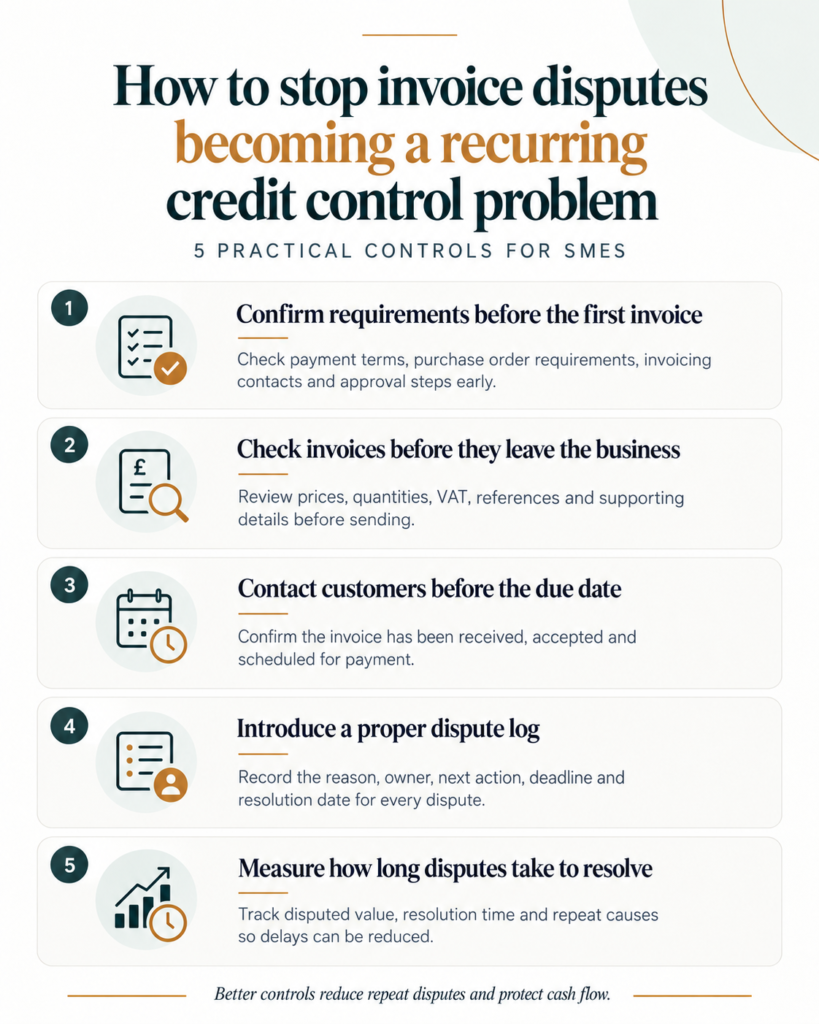
How to stop invoice disputes becoming a recurring credit control problem
If the same disputes keep appearing, I’d start looking further back in the order-to-cash process.
A credit controller can resolve individual queries, but that won’t fix a recurring problem with sales handovers, order approvals, invoicing or service delivery.
I’d recommend putting five controls in place.
1. Confirm the requirements before the first invoice
Make sure somebody has checked the customer’s payment terms, purchase order requirements, invoicing contact and any approval process.
Your sales and operations teams need to understand these requirements too.
2. Check invoices before they leave the business
The invoice should match the approved quotation, purchase order or contractual agreement.
Check prices, quantities, customer details, VAT, additional charges and supporting documents.
3. Contact customers before the due date
For higher-value accounts, I favour a proactive check that the invoice has been received, accepted for processing and scheduled for payment.
This is often a useful opportunity to uncover issues while there’s still time to resolve them.
4. Introduce a proper dispute log
If you’re relying on an email inbox or someone’s memory to track invoice disputes, important details can easily be missed.
At a minimum, I’d record:
- Customer and invoice reference.
- Value of the invoice and amount disputed.
- Date the dispute was first raised.
- Reason for the dispute.
- Person responsible for resolving it.
- Next action and deadline.
- Date of resolution.
- Agreed payment date.
Keep disputed balances visible within your aged debt reporting so you don’t lose sight of the money at risk.
5. Measure how long disputes take to resolve
Most businesses monitor the total value of overdue invoices.
I’d also want to know how much of that balance is disputed, how long those queries remain open and which causes appear repeatedly.
Three particularly useful measures are:
- Disputed invoice value: How much of your outstanding debt is currently affected by queries?
- Average dispute resolution time: How many working days pass between the dispute being raised and its resolution?
- Repeat dispute causes: Which errors, departments or customer processes are responsible for recurring delays?
That information can show you where payment is being held up unnecessarily.
My advice: pay attention to what your disputes are telling you
When I ran FJCM, the business recovered more than £25 million for clients. That experience reinforced the importance of having a proper process for dealing with overdue accounts.
Credit control becomes much harder when disputed invoices are left without a clear next step.
And if the same types of dispute keep happening, I’d question whether the problem starts earlier, when orders are accepted, payment expectations are agreed or invoices are prepared.
Every unresolved dispute should have an owner, a deadline and a documented route towards resolution.
Once a dispute is closed, I’d also want to know whether we’ve addressed the reason it happened in the first place.
Otherwise, there’s every chance the same issue will appear on another invoice next month.
Frequently asked questions about invoice disputes
Can a customer refuse to pay a disputed invoice?
A customer can challenge an invoice if they believe the amount or underlying obligation is incorrect. Whether they can lawfully withhold all or part of the payment depends on the contract, the nature of the dispute and the applicable law.
Establish the exact amount disputed and consider whether payment of any genuinely undisputed balance can proceed.
How long does a customer have to dispute an invoice in the UK?
As of October 2026, there is no universal statutory 30-day deadline for raising a commercial invoice dispute. Contractual provisions and applicable legal rules may affect the position.
The proposed Commercial Payments Bill includes changes concerning invoice dispute time limits, but businesses shouldn’t treat those proposals as law until the relevant provisions come into force.
How long should an invoice dispute take to resolve?
There’s no single timescale suitable for every dispute.
Straightforward invoice errors or missing information can often be resolved within a few working days. Complex disputes involving contracts, service quality or additional work may take longer.
I’d set an internal response deadline, assign responsibility and keep the customer informed until the issue is closed.
Can you charge interest on a disputed invoice?
Interest may be recoverable on qualifying late commercial debts, but the position is more complicated where the underlying invoice is genuinely disputed.
Establish the contractual and legal position before claiming interest or compensation on a contested amount.
Need help getting disputed invoices moving again?
If you’ve got several unpaid invoices sitting on your aged debtor report and you’re unsure which ones to chase, query or escalate, our Aged debt action plan & templates can help you work through the accounts and decide what action to take next.
If disputes keep happening because of weak terms, invoicing errors or unclear responsibilities, our Credit control review & setup looks at the underlying process and helps you put practical improvements in place.
Or, if you’re dealing with one overdue invoice and need a starting point, download our free overdue invoice checklist.